The never ending wars of habitual aggressors are likely to end up as failures. The dreams of world domination, contradictory to the majority persist to play politics over the lives of men and resources. Like the fog of war based on failed intelligence reports led to the demise of our world influence, the loss of a $3T surplus to a $2.5T deficit in six years, intended for our governance. Worst still, is the planned attack on Syria and Iran.How much more did we learn?....Amor Patriae
WAR IN IRAQ
Wednesday, December 22, 2021
PAPA IN THE MILITARY
MY FATHER CAPTAIN AMADO CATAMBAY....., GSC, PN, RIP
I like to pay tribute to my father as he lay in state before us. I like to begin in his early life, when he was a young lad, his escapades, his thirst for education and eventualy his service to his country. In those days, before the great war, a secondary education was enough and was the average attainment of that generation. College education for the poor was non existent. College was going beyond the means of the family. My grandparents were poor, and with four siblings more to feed, that was enough for the family, they were destined to a life as peasants. My father's perception of the future was dire, there was no future if he stayed in Tanay. He eventualy sought out, beyond this environment, with an eye just looking in at all his landed cousins. Traditions were, only the males of the family inherit the ricefields and lands. My grandmother did not.
He did his college education through servitude as a house boy of a well known professor, his uncle Alejandro at the University of the Philippines at Los Banos in Laguna. One can say that he was blessed in the safekeeping of relatives. If you consider the distance between Tanay with his parents and Los Banos as a matter of 30 miles, no brief vacation or visit to his parents was allowed until he graduated 4 years after in 1940. Such was the privations and spartan life that build the character of my father and maybe why he was suited as a military officer.
His obssesive work habits were formed at this early age. I know beyond everything else, that he was very industrious and this was a source of conflict to his subordinates and between us in later years. Early in his career as a naval officer, seldom we see him for seven years as he was assigned in Mindanao fighting the banditry movements of the muslims.
He will go on to higher positions, to take command of his own ship, then a number of ships as a task force commander, then Chief of Staff of the Philippine Coast Guard, a professor in academia at the National Defense College of the Philippines, a base commander at the Manila Naval Station and Cavite Naval Base at Sangley Pt. But what I remember most was him on the bridge of RPS 1133, and I a pre school kid, looking at a young Lt. taking his ship out to the open seas, out of Manila Bay.
And now the end is here, I still see him as a young man full of vigor and strength. He was and will always be my mentor on how to survive the tough streets of life.
In tribute to his service to his country of birth, an allegory written in the second half of the 19th century that befits him.
O Captain! my Captain! rise up and hear the bells; Rise up-for you the flag is flung-for you the bugle trills; For you bouquets and ribbon'd wreaths-for you the shores a-crowding; For you they call, the swaying mass, their eager faces turning; Here Captain! dear father! This arm beneath your head; It is some dream that on the deck, You've fallen cold and dead.
My Captain does not answer, his lips are pale and still; My father does not feel my arm, he has no pulse nor will; The ship is anchor'd safe and sound, its voyage closed and done; From fearful trip, the victor ship, comes in with object won; Exult, O shores, and ring, O bells! But I, with mournful tread, Walk the deck my Captain lies, Fallen cold and dead.
How I longed for the old days, when a soldier has honor in his heart to serve loyally the country. Where did that saying, honor, Duty and Country gone…. by the wayside. Throughout the history of all nations, political institutions have been shaped, in varying degrees, by military pressure.
In primitive societies, all men, to a greater or lesser extent, are warriors. The survival of the tribe is often dependent on its ability to defend itself militarily.
However, even in the so-called bastion of democracy, the United States, the presence and pervasive political influence of a military-industrial complex was publicly acknowledged by then President Dwight Eisenhower.
At the onset of the Philippine Revolution and the Philippine-American War, the Filipino leaders considered themselves first as soldiers and not as statesmen. Thus Andres Bonifacio led what was essentially a military uprising. The other major leaders were all self-styled generals including Emilio Aguinaldo, Antonio Luna, Miguel Malvar, and Gregorio del Pilar. This is the era of Heroes, where soldiers exist solely to protect and obtain the freedom of the Republic
( Era of Heroes)
Today, we are again witnessing the critical role of the military as we listen to the news from North Africa. In Tunisia, the withdrawal of support of the military caused the downfall of the ruling regime. In Egypt, the big question is supposedly what role the military will take in the current political upheaval.
The soldier’s place in society and in the nation is determined by a large number of factors. According to Andre Courvoisier, in his book Dictionary of Military History, the soldier’s position is moral as he bears arms and is legally permitted to use violence; political and social, through methods of recruitment; moral and technical through the differing types of warfare; and finally circumstantial, whether the soldier is at peace or at war.
In the Western world, the profession of arms and being part of the aristocracy was the common norm for most societies before the 18th century. Even in the Eastern world, warrior castes like the samurai dominated society for many years before the modern era.
In Philippine history, during the pre-Spanish period, the ruling class was also the warrior class. Thus our first heroes were Lapulapu and Rajah Soliman.
By the 18th century two closely linked events happened to change this practice of a warrior aristocracy. The first was the rise of a professional army which brought about a sharper distinction between soldiers and civilians. More and more, war became an affair for professionals.
During the same period, there was a change in the hierarchy of social values on lines similar to those which had already occurred in many mercantile countries. The pursuit of earthly happiness and the search for whatever could be socially beneficial meant that, more and more, those who moved into the foremost rank of society were thinkers, creators of wealth, inventors, merchants, and manufacturers.
At the same time, the growing power of liberal, democratic regimes in the Western world emphasized the subordination of military to political authority. This was partly due to the growing distrust of armies and military commanders. The army was supposed to be an instrument in the government’s hands and, as such, should have no political ambitions of its own.
Since they are supposed to stay out of politics, 21st century armies could act in this environment only as a pressure group working primarily for the preservation of national defense interests primarily for the maintenance or increase of the share of the armed forces in the national budget. This is normally done through close contacts with industrialists and politicians and through other various organizations with links to the armed forces such as veteran’s associations.
In every country, war means that the military assumes a leading role and that the work of the nation has to be adapted to the necessities of the struggle.
However, during the past centuries as the Western powers started colonizing the rest of the world, the use of military power to suppress dissent in the colonies became a standard practice. In these so-called Third World countries, the military became the symbol of authority and order.
My father as CO Home Defense Command in the field of encounter with dissidents Mindanao, Philippines
It is not surprising that in the states that arose out of the decolonization process, in Latin America in the 19th century, and in Africa and Asia in the 20th century, military dictatorships arose. The military elite often justified their seizure of power by the need to suppress "subversive" elements and often proclaimed the priority of civil over military power. They would promise the early establishment of a constitutional regime following free elections and the end of what supposed would be merely a provisional dictatorship. However, in most circumstances, the outcome would be the postponement of such an outcome.
This is what happened to the Philippines when Marcos declared martial law and promised free elections which never came.
The abuse of civil rights among the citizenry, in the guise of national security, comes from the advise of a surprisingly foreign institution. The US military advisers of the Joint US Military Advisory Group (JUSMAG) and the CIA station in Manila designed and led the bloody suppression of the nationalist Hukbong Mapagpalaya ng Bayan (HMB) which was vehemently opposed to the post-war Parity Rights amendment and the onerous military agreements with the United States. The CIA's success in crushing the peasant-based Huk rebellion in the 1950s made this operation the model for future counterinsurgency operations in Vietnam and Latin America. Colonel Lansdale and his Filipino sidekick, Col. Napoleon Valeriano were later to use their counter guerrilla experience in the Philippines for training covert operatives in Vietnam and in the US-administered School of the Americas, which trained counter guerrilla assassins for Latin America. Thus, the Philippines had become the CIA's prototype in successful covert operations and psychological warfare.
After this stint in the Philippines using propaganda, psywar and deception against the Huk movement, it was then used in Vietnam to wage military, political and psychological warfare. It was the CIA view that the tactics that they used to solve the problem in the Philippines were applicable to Vietnam. They were wrong. In 1975, after two decades of protracted warfare, the Vietnamese people defeated the strongest superpower on earth.
Today, in the 21st century, there is a temptation in some quarters to again look to the military as the final arbiter in a political struggle. The lessons of history should teach us that a democratic society cannot exist with the existence of two separate societies -- civil and military. The memory left to us by the story of civilization is that the most progressive and liberal societies are those where the rule of law prevails and where the predominant authority was civilian.
Society is deemed to be in danger of security forces. There are over a hundred political prisoners in jail, and detainees continue to be tortured and mistreated during interrogations. The security forces have been responsible for a number of forced "disappearances" and extra-judicial executions, while private security forces and unidentified armed men have responsible for the killings and harassment of civilians in the context of land disputes. Muslim armed opposition groups have also been responsible for kidnappings and arbitrary killings. Hundreds of people continue to be sentenced to death by the civilian courts.
The military corruption in the Philippines is not
unique. It seems to prevail in all previous Spanish, French, Dutch, and Italian colonies in Asia, Latin America and Africa. The degree of corruption is related to their civilian masters’ integrity. The Marcos dictatorship, politicized the military, to the degree that the institution can never be revitalized like the times of my father or my ancestors. They served their country honorably as poor men with dignity, and they went to their graves with honor. Nowadays the concept of honesty among the military is non existent. The young flock to the academy not for honor , duty and country, but in search for security, booties and fortune.
Going Home
A Japanese air raid on 10 December 1941 leaves the Cavite Navy Yard in flames.
I remember my father on the bridge of RPS 1133, like the ship on the right. I was a pre school kid then, looking at a young Lt. taking his ship out to the open seas, out of Manila Bay. 1960: I became aware of my heritage in my junior year at UP Prep and began preparation for my appointment as a cadet at the PMA at Fort Del Pilar. This was a period in my teen years that I remember fondly, memories in my High School, of the hectic days, dashing thru the corridors catching my schedule of classes at Rizal Hall. I recall my bag loaded with books, eager, wide eyed, and quick to learn the tenets of math, the arts and sciences.
I remember past friends and stormy situations that most teenagers weathered through. As in life surviving the unspoken pecking order among bigger classmates and the so called in crowd was the rule. That lone wolf streak that kept me apart, which peers seemed to see as a weakness was a measure of heritage that set me off from the current teenage precepts of the day. Later, when of age and after further studies, having ever spurred curiosity, whetted my appetite for a life of adventure, of soldiering and foreign lands.
Dewey Blvd: The jetty potruding out to Manila Bay is the future Cultural Center, on the other side of Dewey is the Manila Naval Station (MNS) where we lived from 1965 to 1966. the headquarters of the Philippine Navy was relegated to a small block of land south of the Manila Yacht Club. The original plan was to reclaim the site of the cultural center(CC) to replace the location of the MNS by the Central Bank. Imelda Marcos, saw this valuable real state and confiscated the plan for her project the now CC. The yacht club remained, the Navy base (MNS) was transferred to Fort Bonifacio.
Phillipines Naval Special OperationsA member of the Naval Special Operations Group (NAVSOG) fires his automatic sub-machine gun during an anti-terrorism rescue operation at the Philippine Navy headquarters in Sangley Point, Cavite
Fort San Antonio Abad Malate; Manila
Fort San Antonio Abad • Manila
Looking across Manila Bay on top of the wall of Fort San Antonio Abad in Malate, Philippines.This picture shows how close Manila Bay was to the Fort prior to the Cultural Center. Right breakwater MNS
The old Navy base inside Manila Naval Station at Dewey Blvd. adjacent to the Manila Yacht Club. The Manila Cultural Center foreground/below
Papa and his various duty assignments in the 60's who left our midst Feb. 2010. Early in his career as a naval officer, seldom we see him for a decade as he was out to the Southern seas in Mindanao fighting the banditry and secession movements of the muslims. He will go on to higher positions, to take command of his own ship, then a number of ships as a task force commander, then Chief of Staff of the Philippine Coast Guard, a professor in academia at the National Defense College of the Philippines, Dean at the Command and General Staff College, a base commander at the Manila Naval Station and Cavite Naval Base at Sangley Pt. But what I remember most was him on the bridge of RPS 1133, and I a pre school kid, looking at a young Lt. taking his ship out to the open seas, out of Manila Bay.
Ramparts of Fort San Antonio Abad where the old HQ of MNS was an addendum perched on top. The old building is gone but the fort remains in its original grandeur.
Manila Bay is a natural harbour which serves the Port of Manila (on Luzon), in the Philippines. The bay is considered to be one of the best natural harbours in Southeast Asia and one of the finest in the world. Strategically located around the capital city of the Philippines, Manila Bay simplified commerce and trade between the Philippines and its neighbouring countries, becoming the gateway for socio - economic development even before Spanish occupation. With an area of 1,994 km 2 (769.9 sq mi), and a coastline of 190 km ( 118.1 mi ), Manila Bay is situated in the western part of Luzon and is bounded by Cavite and Metro Manila on the east, Bulacan and Pampanga on the north, and Bataan on the west and northwest. Manila Bay drains about 17,000 km 2 ( 6,563.7 sq mi ) of watershed area, with the Pampanga River contributing about 49% of the freshwater influx. With an average depth of 17 m ( 55.8 ft ), it is estimated to have a total volume of 28.9 billion cubic meters ( 28.9 cubic km ). Entrance to the bay is 19 km ( 11.8 mi ) wide and expands to a width of 48 km (29.8 mi). However, width of the bay varies from 22 km ( 13.7 mi ) at its mouth and expanding to 60 km (37.3 mi) at its widest point. The islands of Corregidor and Caballo divides the entrance into two channels, about two miles ( 3.2 km ) towards the North and 6.5 miles (10.5 km) wide on the South side. Mariveles, in the province of Bataan, is an anchorage just inside the northern entrance and Sangley Point is the former location of Cavite Naval Base. On either side of the bay are volcanic peaks topped with tropical foliage: 40 km to the north is the Bataan Peninsula and to the south is the province of Cavite.
Corregidor Mile Long Barracks
Sangley Point My father became the CO of Sangley Point Cavite Naval Base in the 70’s.1960-photo
Ayuntamiento Building, Intramuros, Manila
Papa in the 60's as Commanding Officer(CO) MNS, extreme left Cdr. Oscar L. Tempongko
PAPA AT NORFOLK VA WITH CLASSMATES
Anchor at Fort San Antonio AbadWall of Fort San Antonio Abad
MNS nowJose V. Andrada Naval Station Manila, Philippines.
FORT SAN ANTONIO ABAD
Across the entrance to Manila Bay are several islands, the largest of which is Corregidor, located three kilometres from Bataan and, along with the island of Caballo, separates the mouth of the bay into the North and South Channels. In the south channel is El Fraile Island and outside the entrance, and to the south, is Carabao Island. El Fraile, a rocky island some four acres ( 1.6 ha ) in area, supports the massive concrete and steel ruins of Fort Drum, an island fortress constructed by the United States Army to defend the southern entrance of the bay. To the immediate north and south are additional harbors, on which both local and international ports are situated. Large number of ships at the North and South harbors facilitate maritime activities in the bay. Being smaller of the two harbors, the North Harbor is used for inter-island shipping while the South Harbor is used for large ocean-going vessels. Manila Bay was connected to Laguna Lake ( or Laguna de Bai) about 3,000 years ago. Recurring episodic uplifts along the West Marikina Valley Fault caused the two to break up. Interaction between Manila Bay and Laguna Lake occurs only through Pasig River. The bay was the setting for the Battle of Manila Bay in 1898 in which American troops led by Commodore George Dewey, seized the area. Significantly, this battle showcased the United States' naval strength when all major Spanish ships were destroyed and captured. With its proud historic past and the place brimming with marine life, Manila Bay became the ocean portal to its epicentre for government, economy and industry. Seven years later during the Russo-Japanese War at the close of the Battle of Tsushima in 1905, three surviving Russian protected cruisers, the Aurora, Zhemchug, and Oleg, managed to make port in then-United States-controlled Manila for repairs. But because the US was a neutral power, the trio of warships and their crews remained interned by the U.S. until the war officially ended in September that year. In World War II, Corregidor Island was annexed by Japanese forces fighting from this bay once again in 1942. Even earlier various other battles were fought from this naval base including the La Naval de Manila in 1646, which finally put a stop gate to the Dutch trials to seize the Philippines
Baywalk, Roxas Boulevard
caballo island
Defense Secretary Ramon Magsaysay overseeing the capture of William Pomeroy, an American ideologist and leader of the Nueva Ecija Huk Propaganda Corps. Prior to assuming the presidency, RM was Defense Secretary in Pres. Elpidio Quirino’s Cabinet. For more information on the capture of William Pomeroy
Atty. Diosdado Macapagal raises the Philippine flag at Turtle Islands
Atty. Macapagal got his first break as a public figure in 1948 when Vice President Quirino, then concurrently Secretary of Foreign Affairs, appointed him as Assistant Chief of its Law Division and assigned him to negotiate the return of the administration of the Turtle Islands from the United Kingdom to the Philippines. He succeeded and [Vice President] Quirino gave him the privilege of raising the Philippine flag over the islands.
Ruins at Corregidor
Ferry Dock
I remember this building pretty well. When I was a child, my mother and I would collect the salary from the cashier’s office, while my father was away on missions. Then later on, lived across Roxas Blvd. when father was the CO of the Manila Naval Station. Above is the Philippine Navy headquarter building in Metro Manila. This was also the venue of my High School graduation ball at the officer’s club in 1961.
Hospital Jabidah Grafitti. There is another story of Corregidor that is much less well known. Back in 1968, there was a slaughter of muslim Filipino soldiers training on the island by then Philippine President Ferdinand Marcos which became known as the Jabidah Massacre. To make a long story short for my American friends think of it in these terms: It's as If President Kennedy during the Bay of Pigs had killed all the Cubans he trained to invade Cuba because they changed their minds and refused to go through with it. Having a large force of disgruntled, well trained and armed revolutionaries on Corregidor, Marcos decided to have them liquidated. On 18 March 1968, all these specially trained soldiers meant to invade the Malaysian island of Sabah were murdered at Kindley Airfield. As the story is told from the Corregidor guide, these soldiers that were killed apparently wrote their names on the walls of the hospital in the days preceding their deaths.
I missed this early morning and late afternoon call to the
colors at (MNS), this bugle call melody is used to accompany the raising of the Flag (the national colors). It's used when no band is available to render honors. "When it's played on military bases, all uniformed personnel are required to come to attention and present a salute, either to the flag, or in the direction of the music if the flag is not visible".
When World War II began, the Philippines had no significant naval forces after the United States withdrew the Asiatic Fleet following the Attack on Pearl Harbor by the Imperial Japanese Navy. The ThPhilippines had to rely on its OSP with headquarters located at Muelle Del Codo, Port Area, Manila which composed of a high-speed Thorneycroft Coast Motor Boat (CMB) 55-foot (17 m) and 65-foot (20 m) PT boats, to repel Japanese attacks from the sea.During the course of the war, surviving personnel of the Offshore Patrol conducted guerilla hit-and-run attacks against the occupying Japanese forces.
Corregidor on the horizon. Between December 24, 1941 and February 19, 1942, Corregidor became the temporary location for the Government of the Philippines. On December 30, 1941, outside the Malinta Tunnel, Manuel L. Quezon andSergio Osmeña were inaugurated respectively as President and Vice-President of the Philippines Commonwealth for a second term.
The Tail of Corregidor Island with Hooker's Point at the farthest end
Friday, July 21, 2006
My Father with MNS officers Circa 1964
My father in the Southern Philippines Seas aboard a corvette Circa 1948
Camp O'Donnel (Capas Tarlac). the American sector of the war memorial.
The Cement Cross
In wishing to honor our comrades who died so far away from home the battling bastards of Bataan Death March commissioned the construction of this Replica of the “Cement Cross” in the hope that all those who may pass by to view this memorial will remember the many young Americans who gave their lives in defense of their country and of the Philippines.
In June of 1942 the Japanese authorities at the American side of the Prisoner of war enclosure at Camp O” Donnell, two kilometers north of this site presented the prisoners with some Cement. The American Prisoners decided to build a Cement Cross to honor the memory of their dead comrades. Completed later that month. The cross remained hidden amidst tall grass until was discovered by returning American Forces in 1945. Left where it originally stood unknown to most and battered by the elements. The cross was again forgotten. Rediscovered by Bataan Veterans visiting the area in 1961. The cross became the historical symbol of the American Prisoner of war enclosure and its dead. When American military presence ended in the Philippines in 1992. The cross was brought to the National Historic Site Andersonville, Georgia, USA. Where it is now kept and displayed. This Replica stand as a reminder of America’s unprepared ness before the outbreak of World War II.
Libingan ng mga BAYANI
Coast Guard At Port Area Manila left photo, La loma Cemetery next above, Libingan ng mga Bayani (heroes cemetery) Fort Bonifacio close to where we live at the Navy Village, Fort William McKinley then (Fort Bonifacio)
It was the final stage of the tragic death march and a concentration camp with an open field which served as the dumping grave site of Filipino and American soldiers who died with debilitating diseases. It has witnessed the endless sufferings of the sick and the neglected only to die, then dropped in mass with three and half feet depth and those who survived the darkest moments of their lives, they narrated with tears clouding their eyes, the traumatic experiences encountered during their detention, as they gasped with depression and sadness and said CAMP O” Donnell, that was.
Camp O'Donnel (Capas Tarlac). the American sector of the war memorial.
Bataan Death March Box Car
In San Fernando the POW’s where loaded on the trains bound for Capas, Tarlac, The Boxcars normally carried 50 persons, but the Japanese packed them up 100 to 115 Prisoners. At each stop, The Boxcars were open to give the Prisoners fresh Air. The POW’s got off the train at Capas and marched the final kilometer to Camp O” Donnell.
Bataan Death March 1942. Prisoners of war on the Bataan Death March. (U.S. Air Force photo). The Bataan Death March (also known as The Death March of Bataan) took place in the Philippines in 1942 and was later accounted as a Japanese war crime. The 60-mile (97 km) march occurred after the three-month Battle of Bataan, part of the Battle of the Philippines (1941–42), during World War II. In Japanese, it is known as Batān Shi no Kōshin with the same meaning.
Camp O'Donnel (Capas Tarlac). the American sector of the war memorial.
The Cement Cross
In wishing to honor our comrades who died so far away from home the battling bastards of Bataan Death March commissioned the construction of this Replica of the “Cement Cross” in the hope that all those who may pass by to view this memorial will remember the many young Americans who gave their lives in defense of their country and of the Philippines.
In June of 1942 the Japanese authorities at the American side of the Prisoner of war enclosure at Camp O” Donnell, two kilometers north of this site presented the prisoners with some Cement. The American Prisoners decided to build a Cement Cross to honor the memory of their dead comrades. Completed later that month. The cross remained hidden amidst tall grass until was discovered by returning American Forces in 1945. Left where it originally stood unknown to most and battered by the elements. The cross was again forgotten. Rediscovered by Bataan Veterans visiting the area in 1961. The cross became the historical symbol of the American Prisoner of war enclosure and its dead. When American military presence ended in the P
hilippines in 1992. The cross was brought to the National Historic Site Andersonville, Georgia, USA. Where it is now kept and displayed. This Replica stand as a reminder of America’s unprepared ness before the outbreak of World War II.
Libingan ng mga BAYANI
Coast Guard At Port Area Manila left photo, La loma Cemetery next above, Libingan ng mga Bayani (heroes cemetery) Fort Bonifacio close to where we live at the Navy Village, Fort William McKinley then (Fort Bonifacio)
It was the final stage of the tragic death march and a concentration camp with an open field which served as the dumping grave site of Filipino and American soldiers who died with debilitating diseases. It has witnessed the endless sufferings of the sick and the neglected only to die, then dropped in mass with three and half feet depth and those who survived the darkest moments of their lives, they narrated with tears clouding their eyes, the traumatic experiences encountered during their detention, as they gasped with depression and sadness and said CAMP O” Donnell, that was.
Coast Guard Cutter in the Port Area, similar to ships we used to patrol offshore later on.
Remnants of Daniel Burnham's stamp in Manila - the old Dewey Blvd. - now Roxas Blvd. Driving through the boulevard feels like driving through Chicago's Lake Shore Drive ... This picture of the boulevard feels like it was taken from a highrise on Chicago's Lake Shore Drive near Goethe and Inner Drive. The US Embassy is situated along this boulevard around the area of the lights jutting into the bay.
Remnants of Daniel Burnham's stamp in Manila - the old Dewey Blvd. - now Roxas Blvd. Driving through the boulevard feels like driving through Chicago's Lake Shore Drive ... Actually Burnham designed plans for Manila (1905) before he designed Chicago (1909). Parts of the design, based on the City Beautiful movement were implemented - like this boulevard along Manila Bay. He also designed Baguio City, the summer capital of the Philippines, situated up in the mountains of Northern Philippines.
Sarmiento Bldg, Makati, where I worked at Procter & Gamble;
ARISTOCRAT. The closest restaurant to our place at MNS. 432 San Andres St. cor. Roxas Blvd., Malate
Top, movie houses, City Hall,
Right Photo Bagiuo, the terraces and the Lost highway bontoc-mainit (mountain province). A mountain trail in the Cordillera, Philippines.
Rizal Avenue the street was named after Rizal, it was referred to as Calle Dulumbayan. I watched movies at the Ideal, State, Dalisay and Avenue Theaters. Later on ... the Universal Theater and Odeon and Galaxy. And Scala, Apollo, Alegria and Opera House.
In the twilight of age all things seem strange and phantasmal,
As between daylight and dark ghost-like the landscape My heart goes back to wander there,
And among the dreams of the days that were,
I find my lost youth again.
And the strange and beautiful song,
The groves are repeating it still:
"A boy's will is the wind's will,
And the thoughts of youth are long, long thoughts."
I should not be withheld but that some day
into their vastness I should steal away,
Fearless of ever finding open land,
or highway where the slow wheel pours the sand...RF
On the road of life one mile-stone more!
In the book of life one leaf turned o'er!
Like a red seal is the setting sun
On the good and the evil men have done,--
Naught can to-day restore!
Life is real! Life is earnest!
And the grave is not its goal;
Dust thou art, to dust returnest,
Was not spoken of the soul.
Not enjoyment, and not sorrow,
Is our destined end or way;
But to act, that each to-morrow
Find us farther than to-day.
Art is long, and Time is fleeting,
And our hearts, though stout and brave,
Still, like muffled drums, are beating
Funeral marches to the grave.
In the world's broad field of battle,
In the bivouac of Life,
Be not like dumb, driven cattle!
Be a hero in the strife!
Trust no Future, howe'er pleasant!
Let the dead Past bury its dead!
Act,--act in the living Present!
Heart within, and God o'erhead!
Lives of great men all remind us
We can make our lives sublime,
And, departing, leave behind us
Footprints on the sands of time;
Footprints, that perhaps another,
Sailing o'er life's solemn main,
A forlorn and shipwrecked brother,
Seeing, shall take heart again.
Let us, then, be up and doing,
With a heart for any fate;
Still achieving, still pursuing,
Learn to labor and to wait...
Saturday, December 18, 2021
The west should sink those illegal fishing of China as it avoids Kinetic warfare but indulge with media threats
Western history can be seen as having several inflection points: one was 1492, the advent of the “Columbian Era”. The Columbian era is the era of sea-faring, sea-power-based Western colonial and imperial empires. The demise of the Columbian era, was foreshadowed by an Oxford geographer in 1904 who put forth what is now known as the “Heartland Theory”. In a nutshell, it is a land-based theory of power that predicts the end of sea-based powers: “Who rules East Europe (Eurasia) commands the Heartland; who rules the Heartland commands the World-Island; who rules the World-Island commands the world.” It also concluded, “Were the Chinese…to…conquer its territory [of the Russian Empire], they might constitute the yellow peril to the world’s freedom.” This maxim and the anxiety it provoked was red-lined in Brezinski’s “Grand Chess game”: “No Eurasian challenger should emerge that can dominate Eurasia and thus also challenge U.S. global pre-eminence.”
In 1992, Marshall’s protégé, Paul Wolfowitz formulated the above strands into a formal doctrine, in the above mentioned DPG (Defense Planning guidance) document:
“Our first objective is to prevent the re-emergence of a new rival… that poses a threat on the order of that posed formerly by the Soviet Union…to prevent any hostile power from dominating a region to generate global power…The U.S. must… protect a new order that [convinces] potential competitors that they need not aspire to a greater role or pursue a more aggressive posture to protect their legitimate interests. In non-defense areas, we must… discourage them from challenging our leadership or seeking to overturn the established political and economic order. We must maintain the mechanism for deterring potential competitors from even aspiring to a larger regional or global role.”
This can be better understood by looking at a map:
This is a map of the world, drawn from a topologist’s eye. It shows relationships, not distances or area. From this map you can note the following things:
+ China has more borders than any other country in the world. This also gives it the possibility of connecting with more countries than any other.
+ Blue lines/corridors are oceans: The top two thirds is the “world island” or “pivot state”–it contains most of the world’s population, resources, and wealth, and it can be connected as a single entity through overland routes or short ocean hops.
+ The bottom is the Americas. It is topologically isolated from the world island. As sea lane control becomes less important, it will also lose prominence and relative power if the world island unifies. It’s clear that that unifying power will probably arise in China, whose overland paths using high-speed rail, roads, pipelines, and ports can be easily built and connected, in a “new silk road”.
+ The US needs to fracture the world island to maintain its global power. If you color in the places where China is encircled, or where the US is waging war/fracturing societies/creating chaos, this is exactly where the fault lines of the global conflict are, and reveal what US strategy is.
Here is a second map:
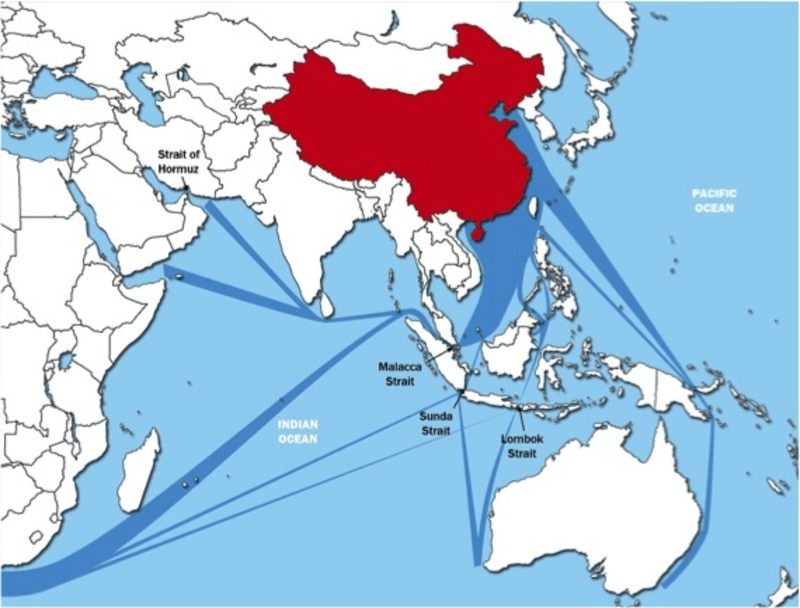
Image: CSBA: Shipping Lanes through the South China Sea.
The US has actually surrounded China with 400 military bases, bristling with strategic and tactical weaponry. It also has war-gamed out China’s key vulnerability: the chokepoint of the South China Sea. War in the South China Sea would disrupt $5.3 Trillion of China’s external trade and 77% of China’s oil imports[5]. In this scenario, the US does not have to win a shooting war with China in the South China Sea. The war just has to happen, and the disruption to trade could crash China’s economy. The map shows the shipping lanes that would be disrupted.
China’s first response to the US pivot and encirclement, especially in the South China Sea–its key chokepoint–was to build defensive military facilities along some of the islands, to deter US incursion and to raise the cost of interference. Its other response, much more ambitious, was the Belt & Road Initiative (BRI), which constitutes a long overland escape from the encirclement, similar to its “long march” during its encirclement by the fascist KMT. The BRI travels through SE Asia, then overland through Central Asia, to the Mediterranean, and then Europe and Africa. In particular:
+ CMEC (China-Myanmar Economic Corridor) travels through Rakhine State and exits to the Indian Ocean at Kyaukphyu port (bypassing the Strait of Malacca).
+ CPEC (China-Pakistan Economic Corridor) to Gwadar port transits directly to the Arabian Sea and the Persian Gulf.
+ Xinjiang is the key overland route for BRI to exit China to Central Asia, with Iran also a key node.
+ Djibouti at the horn of Africa is the entry node to Africa (the Sahel, and the South)
BRI as it does this, becomes the physical realization of Mackinder’s “heartland” in Eurasia—the pivot state connecting the “world island” into a single economic bloc, and raising China to the status of the key regional power, exactly what Brezinski and Wolfowitz, sought to prevent.
Image: Mercator Institute for China Studies: Belt and Road Initiative.
Mindful of this development, and aware of the rapidly ticking biological clock on US power, the US is currently rapidly escalating hostilities in the SCS, most recently with war games, U2 incursions, belligerent passages of aircraft carriers, guided missile destroyers, submarines; China’s response has been to launch “carrier killer” missiles into the region.
In December 2018, Rear Admiral Lou Yuan of the PLA Navy said, ‘What the United States fears the most is taking casualties,’ and suggested that sinking two US aircraft carriers would be sufficient to expel the US from the South and East China seas. ‘We’ll see how frightened America is.’
The authors say that using this concept of ‘offensive deterrence’ by conducting strikes that kill Americans or Australians would not have the deterrent effect the PRC seeks or expects ‘and the risks of escalation from such a deterrent effort are extremely high’.
So, they say, planners must take this into account both when seeking to deter China as well as when thinking through what actions it might take or how it might react to our actions.
In examining how China might be deterred from actions inimical to international goals and standards, the report contains various definitions of what deterrence actually is. One is that of strategist Thomas Schelling, described as the contemporary father of coercion theory: ‘To be coercive, violence has to be anticipated. And it has to be avoidable by accommodation. The power to hurt is bargaining power. To exploit it is diplomacy—vicious diplomacy, but diplomacy.’
Zhao Xijun of the PRC’s National Defense University defines ‘offensive deterrence’ in his book Coercive warfare: a comprehensive discussion on missile deterrence as ‘a military deterrence that mainly aims at attacking’ and writes that ‘the characteristic of offensive deterrence is to use “pre-emptive strike” to deter the other side’. Zhao also states that this concept is ‘“using war to stop war” by [using] small war to constrain large war’.
The authors compare the current situation to the way the US and the Soviet Union related to each other during the Cold War. Apart from contact at organisations such as the United Nations, the two sides had little interaction, little trade, little commerce and relatively little overlap in their geographical spheres of influence.
‘There was tension and conflict on the margins with clear escalatory potential, but the two sides managed to avoid direct or large-scale confrontations, albeit narrowly at times. That was in large part because the two sides developed a shared basic understanding of the world.’
Everyone in the military and the broader defence and security establishment knew something about the Soviets and their military. People studied what the Soviets thought, how they spoke and the actions that they took, down to the smallest details.
Each side developed a solid basis for understanding the signals the other side was sending, and typically sent clear signals of its own.
The authors say that that is not the case today.
‘The CCP’s understanding of the world, and thus its approach to it, is significantly different from Western views. It’s neither right nor wrong, just a different perspective, and one that isn’t common in Western liberal democracies; nor is it commonly taught in Western education systems, or indeed even in professional military education.’
They say that Australian and US partners and allies such as Japan, South Korea, Singapore and Taiwan have a historical appreciation and can help contribute to a better understanding of historical concepts. But, since 2001, the US and many of its partners have been focused on fighting terrorist groups and managing the conflicts in Iraq, Afghanistan and the broader Middle East.
Only during the latter part of the Trump administration did the US truly focus the whole of government on addressing the competition with China, bringing in Congress as well as the military, the State Department, the Committee on Foreign Investment in the United States and others.
While it takes years to build a deep and wide group of specialists in any field, the authors say, it stands out that the US Air Force has the same number of foreign area officer places for Chinese specialists as it does for Portuguese speakers.
They warn that if the US and its allies and partners hope to avoid conflict with China, they must build a deeper shared understanding of how the CCP and the PRC see the world. That will require sustained effort over several years and involve a deep partnership with partners and allies who have vital knowledge and expertise.
They also urge planners not to ‘mirror ourselves onto our analysis of PRC thinking and action’.
They say that: ‘With sustained effort, we can do better at understanding Chinese thought and concepts and the twists that CCP ideology gives them. In that way, we can maximise our opportunities to ensure that our strategic goals are met and our interests are protected.’
Wednesday, December 8, 2021
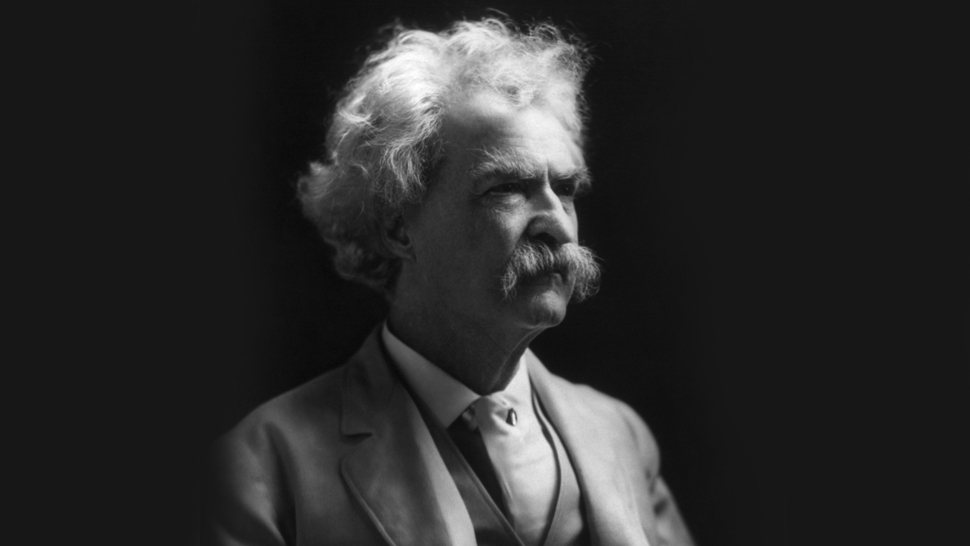
'Let Men Die to Make Us Rich': How Mark Twain Used Poetry to Oppose the Philippine-American War 'I am opposed to having the eagle put its talons on any other land.'
IMAGE WIKIMEDIA COMMONS
American writer Alice Walker once said, “Poetry is the lifeblood of rebellion, revolution, and the raising of consciousness.” We’ve seen this in the literature of Jose Rizal, and had he survived, perhaps he would have had something to say on the atrocities of the Philippine-American War. But lucky for him, and especially for us, another writer lent his voice to the chorus of the anti-imperialism movement of his own country—Mark Twain, the father of American literature.
Having once supported America’s growing empire, Twain, who was born Samuel Langhorne Clemens, changed his tune after he saw the true intentions and consequences of imperialism, becoming a full-fledged anti-imperialist by 1899. In an article by the New York Herald in 1900, Twain admitted that he wanted to see the “American eagle to go screaming into the Pacific.” He saw his country as a savior for the Filipino people who had suffered for 300 years under Spanish rule. “We can make them as free as ourselves.”
But soon enough, Twain was enlightened with the truth. “I have read carefully the treaty of Paris, and I have seen that we do not intend to free, but to subjugate the people of the Philippines. We have gone there to conquer, not to redeem,” said Twain. “And so I am an anti-imperialist. I am opposed to having the eagle put its talons on any other land.”
With his pen as his sword, Twain went on to write about the Moro Crater Massacre, which saw the deaths of almost 1,000 Moro people, and on the hypocrisy of the war against the teachings of Christianity. But it was a certain poem, a parody of the patriotic national poem “The Battle Hymn of the Republic,” that unleashed Twain’s opposition to the Philippine-American War. Naturally, Twain named his version, “The Battle Hymn of the Republic, Updated.”
It doesn’t take a genius to decipher Twain’s poem and read between the lines with phrases like “His lust is marching on.” He goes on to equate the United States of America with Greed, saying “Greed is marching on” and “Greed is seeking out commercial souls before his judgement seat.”
But it’s one of the last lines that bring home Twain’s beliefs on the Philippine-American War:
“As Christ died to make men holy, let men die to make us rich.”
SaveSLC in black suit and tie, seated in armchair. 1904.NYPL Digital CollectionsA photographic portrait of Samuel Clemens, (Mark Twain), 1835-1910. The American Gilded Age author & humorist, he is seated in an armchair c.1904. ~ {cwlyons} ~ (Image: The NYPL)
Read the full poem below:
Mine eyes have seen the orgy of the launching of the Sword; He is searching out the hoardings where the stranger's wealth is stored; He hath loosed his fateful lightnings, and with woe and death has scored; His lust is marching on.
I have seen him in the watch-fires of a hundred circling camps; They have builded him an altar in the Eastern dews and damps; I have read his doomful mission by the dim and flaring lamps— His night is marching on.
I have read his bandit gospel writ in burnished rows of steel: "As ye deal with my pretensions, so with you my wrath shall deal; Let the faithless son of Freedom crush the patriot with his heel; Lo, Greed is marching on!"
We have legalized the strumpet and are guarding her retreat; Greed is seeking out commercial souls before his judgement seat; O, be swift, ye clods, to answer him! be jubilant my feet! Our god is marching on!
In a sordid slime harmonious Greed was born in yonder ditch, With a longing in his bosom—and for others' goods an itch. As Christ died to make men holy, let men die to make us rich— Our god is marching on.
Thursday, December 2, 2021
GEOPOLITICS OF FRANCE: WILL MACRON MAKE EUROPE A SUPER POWER
The 21st century brings great changes for the world order. The French recognize these and want Europe to keep up with the US and China. Will France lead Europe towards a superpower? Welcome to the next episode of The 20s Report.
How President Macron plans to capture Africa's demographic wave by using the French language, with the ultimate goal to cement French hegemony worldwide. BAKU - For centuries, France was a global powerhouse, permeating its will over five continents. Since those imperial days, it has lost considerable ground in its former domains. Only in Africa did France retain its hold, owing to the monetary system that was put in place. In the decade after World War II, President François Mitterand was quoted saying: “Without Africa, France will have no history in the 21st century.” Like a foretelling coming true, it is precisely because of Africa that modern-day France is returning as the global force it once was. And it’s using the soft power attributes of language to cement its hegemony
Can Macron lead the European Union after Merkel retires?
Troops from a European tank battalion that consists of Dutch and German soldiers prepare for an exercise near Oldenburg in northern Germany on Feb. 4, 2019.
After Germans vote Sunday and a new government is formed, Chancellor Angela Merkel will leave office after 16 years as the dominant figure in European politics. It is the moment that French President Emmanuel Macron has been waiting for.
The German chancellor, although credited for navigating multiple crises, was long criticized for lacking strategic vision. Macron, whose more swaggering style has sometimes ruffled his European partners — and Washington — has put forward ideas for a more independent and integrated Europe, better able to act in its own defense and its own interests.
But as the Anglo-American “betrayal” in the Australian submarine affair has underscored, Macron sometimes possesses ambitions beyond his reach. Despite the vacuum Merkel leaves, a Macron era is unlikely to be born.
Instead, analysts say, the European Union is heading for a period of prolonged uncertainty and potential weakness, if not necessarily drift. No one figure — not even Macron or a new German chancellor — will be as influential as Merkel was at her strongest: an authoritative, well-briefed leader who quietly managed compromise and built consensus among a long list of louder and more ideological colleagues.
That raises the prospect of paralysis or of Europe muddling through its challenges — on what to do about an increasingly indifferent America, on China and Russia, and on trade and technology — or even of a more dangerous fracturing of the bloc’s always tentative unity.
And it will mean that Macron, who is up for reelection in April and absorbed in that uncertain campaign, will need to wait for a German government that may not be in place until January or longer, and then work closely with a weaker German chancellor.
“We’ll have a weak German chancellor on top of a larger, less unified coalition,” said Mujtaba Rahman, managing director for Europe of the Eurasia Group, a political risk consultancy. “A weaker chancellor is less capable of exerting influence in Europe, and then with the Macron election, the political cycles of these two key countries will not be in sync.”
The uncertainty is likely to last until after the French parliamentary elections in June — and that is presuming Macron wins.
Macron has argued forcefully that Europe must do more to protect its own interests in a world where China is rising and the United States is focusing on Asia. His officials are already trying to prepare the ground on some key issues, looking forward to January, when France takes over the rotating EU presidency. But given the likelihood of lengthy coalition talks in Germany, the window for accomplishment is narrow.
Macron will need German help. While France and Germany together can no longer run the European Union by themselves, when they agree, they tend to bring the rest of the bloc along with them.
So building a relationship with the new German chancellor, even a weaker one, will be a primary goal for Macron. He must be careful, noted Daniela Schwarzer, executive director for Europe and Eurasia of the Open Societies Foundations, not to scare off the Germans.
“Macron’s leadership is disruptive, and the German style is to change institutions incrementally,” she said. “Both sides will need to think through how they make it possible for the other side to answer constructively.”
French officials understand that substantive change will be slow, and they will want to build on initiatives already underway, like the analysis of Europe’s interests called “the strategic compass” and a modest but steady increase in military spending on new capabilities through the new European Defense Fund and a program called Pesco, intended to promote joint projects and European interoperability.
After the humiliation of the scuttled submarine deal, when Australia suddenly canceled a contract with France and chose a deal with Britain and the United States instead, many of his European colleagues are more likely now to agree with Macron that Europe must be less dependent on Washington and spend at least a little more in its own defense.
Few in Europe, though, want to permanently damage ties with the Americans and NATO.
“Italy wants a stronger Europe, OK, but in NATO — we’re not on the French page on that,” said Marta Dassu, a former Italian deputy foreign minister and director of European affairs at the Aspen Institute.
Italian Prime Minister Mario Draghi, whose voice is respected in Brussels, believes strongly in the trans-Atlantic relationship, Dassu said, adding, “We’re closer to Germany than to France, but without all the ambiguities on Russia and China.”
France also wants to become more assertive using the economic and financial tools Europe already has, especially trade and technology, the officials say. The point, they say, is not to push too hard too fast, but to raise the European game vis-à-vis China and the United States, and try to encourage a culture that is comfortable with power.
But France’s German partners will be going through a period of uncertainty and transition. A new German chancellor is expected to win only one-quarter of the vote and may need to negotiate a coalition agreement among three political parties. That is expected to take at least until Christmas, if not longer.
The new chancellor will also need to get up to speed on European issues, which barely surfaced in the campaign, and build credibility as the newcomer among 26 other leaders.
“So it’s important now to start thinking of concrete French-German wins during a French presidency that Macron can use in a positive way in his campaign,” Schwarzer said. “Because Berlin does not want to ponder a scenario in which Macron loses” to far-right Marine Le Pen or in which euroskeptics like Matteo Salvini take over in Italy.
Whoever wins, German policy toward Europe will remain roughly the same from a country deeply committed to EU ideals, cautious and wanting to preserve stability and unity. The real question is whether any European leader can be the cohesive force Merkel was — and if not, what it will mean for the continent’s future.
“Merkel herself was important in keeping the EU together,” said Ulrich Speck of the German Marshall Fund. “She kept in mind the interests of so many in Europe, especially Central Europe but also Italy, so that everyone could be kept on board.”
Merkel saw the European Union as the core of her policy, said a senior European official, who called her the guardian of true EU values, willing to bend to keep the bloc together, as evidenced by her support for collective debt, previously a German red line, to fund the coronavirus recovery fund.
“Merkel acted as mediator when there have been a lot of centrifugal forces weakening Europe,” said Thomas Kleine-Brockhoff, head of the Berlin office of the German Marshall Fund. “It’s less clear how the next chancellor will position himself or herself and Germany.”
Still, Mark Leonard, director of the European Council on Foreign Relations, noted that “whoever is the chancellor, Germany is still responsible for more than half of Chinese trade with Europe.” Germany is “vastly more important than the other countries on all the big issues, from how to handle China to the tech wars and climate change,” he said.
That means Macron “knows he has to channel German power behind his vision,” he said.
But French and Italian positions will be crucial, too, on important pending financial issues like fiscal and banking integration, trying to complete the single market and monitoring the pandemic recovery fund.
Merkel’s departure may provide an opportunity for the kinds of change Macron desires, even if in vastly scaled-down version. Merkel’s love of the status quo, some analysts argue, was anachronistic at a time when Europe faces so many challenges.
Perhaps most important is the looming debate about whether to alter Europe’s spending rules, which in practical terms means getting agreement from countries to spend more on everything, from defense to climate.
The real problem is that fundamental change would require a treaty change, said Guntram Wolff, director of Bruegel, a Brussels research institution. “You can’t have fiscal and defense integration by stealth,” he said. “It won’t have legitimacy and won’t be accepted by citizens.”
But the German election debates ignored these broad issues, he said.
“The sad news,” Wolff said, “is that none of the three chancellor candidates campaigned on any of this, so my baseline expectation is continued muddling forward.”
Who will lead Europe after Merkel? Presidents and prime ministers jockey for the job.
German Chancellor Angela Merkel prepares to lead the last cabinet meeting of the German government ahead of the national elections.
As Germany prepares to elect its next chancellor Sunday, Europe is readying itself for a major shake-up of the unofficial hierarchy of continental leaders.
In nearly 16 years at the helm of Europe’s largest economy, Angela Merkel became the de facto representative on the world stage and the European Union’s chief power broker through countless late-night negotiations and a string of crises.
Germany will continue to wield immense influence. However, Merkel’s experience and reputation give her clout that none of her potential successors as chancellor could hope to match anytime soon. And so her departure will create an opening — for the first time in more than a decade — for other leaders to assert themselves and their vision for Europe.
A few favorites have emerged in the competition. French President Emmanuel Macron, head of the European Union’s second-biggest economy, has been jockeying for years to be the next leader of Europe. Italian Prime Minister Mario Draghi, best known for saving the euro while president of the European Central Bank, also has several of the necessary credentials.
But analysts, politicians and diplomats tend to agree that no one person is capable of filling Merkel’s loafers. Instead, they say, it will probably involve a coterie of premiers — probably all of them men.
“Merkel’s exit creates a problem with leadership, a hole at the heart of Europe,” said Giovanni Orsina, director of Luiss Guido Carli University’s School of Government in Rome. “Either the new chancellor fills that void, or we need to conceive of a collective convergence.”
There will be a marked shift in the balance of power, said a senior E.U. diplomat, and other European leaders will have to step up.
“This cannot only be done by one. It has to be done by the group,” he said, speaking on the condition of anonymity to discuss the sensitive political situation.
Merkel isn’t expected to leave office immediately after the election. The results are likely to be messy, and coalition talks could go through the end of the year — or beyond. Merkel would stay on as a caretaker until a new government is formed.
And then? Whoever steps into the job — the candidates include Armin Laschet, Olaf Scholz and Annalena Baerbock — would need time to settle in, and to establish themselves, before they could expect to command the sort of attention that Merkel has in Europe and internationally.
“Any German chancellor will move into a powerful position,” said Daniela Schwarzer, executive director for Europe and Eurasia at the Open Society Foundations. “Any next German chancellor will bring some experience and bring the same weight of the country to the table, but the personal weight will not be the same.”
If Britain were still in the European Union, some of the power might shift across the English Channel. But in a post-Brexit world, London cannot expect to speak on behalf of the continent.
So, many heads are turning toward Paris.
German Chancellor Angela Merkel and French President Emmanuel Macron meet for a working dinner at the Élysée Palace in Paris on Sept. 16. (Ludovic Marin/AFP/Getty Images)
“The German elections are being seen in France as an opportunity for a reset, where whoever comes in will have less stature than Macron does and whereby France’s influence in Europe would be increased,” said Nicholas Dungan, a senior fellow at the Atlantic Council.
Macron has been preparing for this moment. He has repeatedly sought to emphasize his foreign policy experience, drawing a contrast with the German chancellor candidates, who spent most of their televised debates bickering about domestic politics.
Macron also has spent years outlining his vision for Europe.
In 2017, after another German election, he delivered a sweeping speech at Sorbonne University, arguing that the best response to ascendant nationalists was to acknowledge the European Union’s shortcomings — it is “too weak, too slow, too inefficient” — and then to work to make it stronger and more united.
He has reprised the theme many times. But his proposals — to integrate European defense, reform the euro zone, develop a common asylum policy and impose a new tax on U.S. tech giants — have not been enthusiastically embraced.
The French president has lately been using the chaotic Afghanistan withdrawal, and a fight with the Biden administration over a nuclear submarine deal, to reiterate a call for European “strategic independence.” Other E.U. leaders have said they stand with France in the submarine spat, and they are equally frustrated about Afghanistan. Still, the idea of an E.U. military is far from becoming a reality.
Macron’s mandate as Europe-wide leader may depend in part on how much progress he makes when France takes over the Council of the European Union’s rotating six-month presidency in January — as well as on his showing in France’s presidential election in April. His main competitor, far-right leader Marine Le Pen, has a radically different view of the European project.
“To the question who will take the mantle, you already know the answer: It will be Macron,” an E.U. diplomat said, speaking on the condition of anonymity to offer a candid assessment. “The next question is: Will he retain the mantle?”
The determining factor, the diplomat said, may be whether Macron can learn to compromise.
“Macron has the tools and the chance to, for now, fill that void,” the diplomat said. “But he will only stay there in that position if he manages to bridge the gap between him and his way of doing things, and the east and the north and everybody else. That was Merkel’s way.”
Merkel’s critics, however, sometimes hold that against her. They say she delayed decisions at the E.U. level in an effort to preserve consensus and avoid conflict — and while doing so allowed for the erosion of democratic norms in countries such as Hungary and Poland. Her approach even earned its own verb: “Merkeln,” meaning to dither or bide one’s time.
“During the Merkel era, one always tried to handle and solve things among the 27, often postponing until the very last minute the required solutions for Europe, because of Merkel’s conviction that results could only be yielded by standing together,” said Sandro Gozi, a veteran Italian politician who now represents France in the European Parliament as part of Macron’s centrist “Renaissance” list.
“I believe Macron and Draghi can make all the difference here,” Gozi said.
Italian Prime Minister Mario Draghi, left, and French President Emmanuel Macron walk together before a dinner in Marseille, France, on Sept. 2. (Ludovic Marin/AP)
The French president and Italian prime minister were dubbed Europe’s “new power couple” by Politico in July, amid reports of a transalpine bromance. The two men, separated in age by 30 years, are both former investment bankers and longtime E.U. boosters, and have similar goals for the 27-nation bloc, especially on fiscal policies, where both favor further financial integration.
“I believe that in this new phase, leadership could be collective,” Gozi said. “I see Macron and Draghi as protagonists of that.”
At first, their leadership of Europe would be “two-legged,” Gozi said, but it would eventually include the new German chancellor. Indeed, many observers expect Macron would need strong German partnership to execute the most ambitious of his plans. But Gozi said the result would be “less Merkel-ian” — with faster action and less caution.
Draghi has been positioning himself to take on a greater leadership role, observers say. He was a prominent voice in Europe’s reaction to the Afghanistan withdrawal, pushing for an emergency summit of the G-20, criticizing the European Union’s disorganized stance on accepting refugees, and calling President Biden during the evacuation efforts. In March, Draghi made headlines when he blocked the export of a batch of AstraZeneca coronavirus vaccine doses from the European Union amid a shortage inside the bloc. And he has been talking of using nearly $235 billion in E.U. money to enact an “epochal” pandemic recovery.
But his own sway may be limited by the size and influence of his country.
“The problem across history is not only who you are but the kind of car you’re driving,” said Orsina, of Luiss Guido Carli University. “Some things you can only do if you’re Germany, otherwise it’s that much harder, regardless of the leader’s personality.”
A number of other leaders will be elbowing for a more important role, including Spanish Prime Minister Pedro Sánchez and Dutch Prime Minister Mark Rutte. Both share one obvious trait with their counterparts in France and Italy: They’re men.
After Merkel’s departure, council summits risk taking on the feel of an old boys’ club, said Open Society’s Schwarzer.
“There’s a certain element of having a female leader at the table — the balance will shift in that regard, as well, and that does make a difference in group dynamics,” she said. “Not only what happens in the room but the reception of politics.”
Some Europeans are sure to welcome Merkel’s egress as a chance for potential realignment and more substantive reforms to the European Union.
The Merkel era “has led to a Europe that is highly dependent on Germany and Germany’s choices,” said Rosa Balfour, the director of Carnegie Europe. “The gravity of power has shifted to Berlin, and it hasn’t been all for the good of the rest of Europe. If there’s a slight change in the balance of power, tipped in the favor of a broader pioneering group, from a European perspective there could be benefit in that.”
Critics argue, for instance, that Germany’s response to the euro-zone debt crisis and its push for austerity measures did deep and lasting damage to Greece and Italy, Balfour said.
Still, Merkel’s support remains strong across the continent — yet another indicator of how difficult she will be to replace. A recent survey by the European Council on Foreign Relations asked residents in 12 E.U. nations who they would vote for in a hypothetical election for president of Europe, Merkel or Macron.
Wednesday, December 1, 2021
GEOPOLITICS OF ROMANIA
US army tanks and soldiers continued being deployed on Tuesday to an air base in southern Romania, after the first shipment of tanks had arrived the day before. The tanks were offloaded from a train in the village of Mihail Kogalniceanu, where they would be taken to a nearby military air base. The deployment, known as Operation Atlantic Resolve, is part of an American operation to reassure NATO allies and other partners concerned about Russia. Five hundred US soldiers will eventually be deployed at the Mihail Kogalniceanu Air Base in Constanta County. The operation foresees the continuous presence of an American armoured brigade combat team in Europe on a nine-month rotational basis.
US to Turn Romanian Airbase into NATO Black Sea Hub
A $152 million US-funded construction project will turn the former Soviet base of Campia Turzii in central Romania into new major hub for NATO aircraft in the Black Sea region.
A US Air Force F16 jet takes off during the joint Romanian-US military drill ‘Dacian Viper 2014’ at the Campia Turzii military airbase, April 2014. Archive photo: EPA/MIRCEA ROSCA
The US Air Force will this month start awarding contracts for construction work to upgrade the Campia Turzii base, enabling it to support heavy cargo aircraft and host fighter jets, boosting NATO’s capacities in the Black Sea area.
“We are getting ready to award four projects for construction between May and August 2021,” Darren Walls, a design and construction program manager at the European Deterrence Initiative launched by the US after Russia’s annexation of Crimea in 2014, said in a US Air Force statement quoted on Tuesday by Romanian media.
“The upgrade is important because Romania needs to boost its capacity to receive further NATO aircraft in case of a crisis or conflict that require a collective response,” former Romanian official and security expert Claudiu Degeratu told BIRN.
“Romania also needs a second major air base that meets NATO standards so it can serve its newly acquired F-16 jets,” Degeratu added.
He said that Russia’s buildup of troops around the Ukrainian border in April “shows that a quick renovation of the Campia Turzii base is needed”.
Romania and its US allies already have a large NATO airbase at Mihail Kogalniceanu near the Black Sea. The improvements at Campia Turzii will increase the US and NATO’s capabilities to respond to any potential threats and deter Russia in the region.
US Navy Captain Scott Raymont, the US European Command’s Logistic Directorate chief engineer, explained recently that the reconstruction works at Campia Turzii “include the construction of airfield infrastructure and supporting facilities necessary”.
This will enable the base “to sustain the [US] Air Force’s combat operation and surveillance missions while increasing logistics capabilities in the theatre”, he added.
Following Russia’s annexation of Crimea, the Black Sea has become a strategic priority for the US and NATO defence in Europe, as the Kremlin has heavily increased its activity and presence near the Western military alliance’s south-eastern flank.
As a result, the US and Romania have intensified their military cooperation. Former US President Donald Trump’s administration planned to redeploy some of the US troops he ordered out of Germany last year to Romania and Poland – a move welcomed by Romanian and Polish officials.
On May 10 this year, leaders of Central and Eastern European NATO member states met in Bucharest to discuss the recent mass deployment of Russian troops near the Ukrainian border.
“I advocated a bigger presence of the alliance and the US in the south of the [NATO] eastern flank,” Romanian President Klaus Iohannis said he told his US counterpart Joe Biden, who took part in the summit remotely.
Security analyst Degeratu said this was “a message to Biden so he continues Trump’s policy to redeploy troops in the region”.
Romania Unveils Patriot Missile System on Black Sea
Romania has become the first country to have a Patriot surface-to-air missile system in the Black Sea region, an area where Russia is increasingly perceived as a growing threat by Romania, the US and their NATO allies.
The Patriot surface-to-air missile system unveiled today in the Cape Midia, Romania. Photo: BIRN
Romania on Thursday received the first Patriot surface-to-air missile system acquired from US defense giants Raytheon and Lockheed-Martin, which has been hailed as a crucial step towards strengthening the country’s air defences in the Black Sea region, where Russia is increasingly active.
“The set-up of the first Patriot system is only a first step towards building a formidable air defence capability for our country, which will significantly contribute to consolidating deterrence and the defence of NATO on its eastern flank,” Romania’s Defence Minister, Nicolae Ciuca, said at the unveiling ceremony at the Cape Midia military base near the Black Sea port of Constanta.
Following the arrival of the first Patriot missile system, the Romanian military will receive another three missile systems in future. The remaining three missile systems will be delivered from 2022, military sources told BIRN.
Speaking at Cape Midia, the US ambassador to Bucharest, Adrian Zuckerman, saluted the acquisition of the Patriot system as a stride towards Romania becoming capable of defending itself and its NATO allies from threats. He singled out Russia and China among these threats.
Romania is the seventh NATO country to acquire Patriot missile systems, the first in the Black Sea region and the second in Eastern Europe after Poland.
Globally, Romania is the 17th country to buy this US-built defence technology – Patriot being the acronym of Phased Array Tracking Radar to Intercept on Target – and which is capable of intercepting aircraft and both cruise and ballistic missiles.
“The acquisition of these systems solves a big problem for Romania’s national defence system,” military expert Claudiu Degeratu told BIRN. “We inherited only missile systems produced in the former USSR; Romania did not acquire anything of relevance in this field after [the advent of democracy in] 1990,” he added.
Degeratu explained that the purchase of the Patriot systems should be seen in the light of Russia’s “accelerated militarization of the peninsula of Crimea following its annexation of this region”, from Ukraine in 2014.
“The Russian Federation has deployed new fighter aircraft, new modern missile systems, and warships equipped with short, medium and long-range missiles, including supersonic and submarine missiles,” the same expert said.
In recent years, Romania has stepped up its defence capabilities in order to deter Russian advances in the region following the seizure of Crimea.
Since then, Russia has significantly increased its military might in the Black Sea, which Romania and its allies in NATO perceive as a threat.
These and other geopolitical developments have turned Romania into a cornerstone of US and NATO defence strategy in Europe.
Following the withdrawal of nearly 12,000 US troops from Germany, US officials have announced an intention to redeploy some them to Poland and Romania, to reinforce deterrence of Russia on NATO’s eastern flank.
The US already has two military bases in Romania and is planning to invest in turning the former Soviet airbase of Campia Turzii in Transylvania into a major hub from which to boost reconnaissance patrols over the Black Sea.